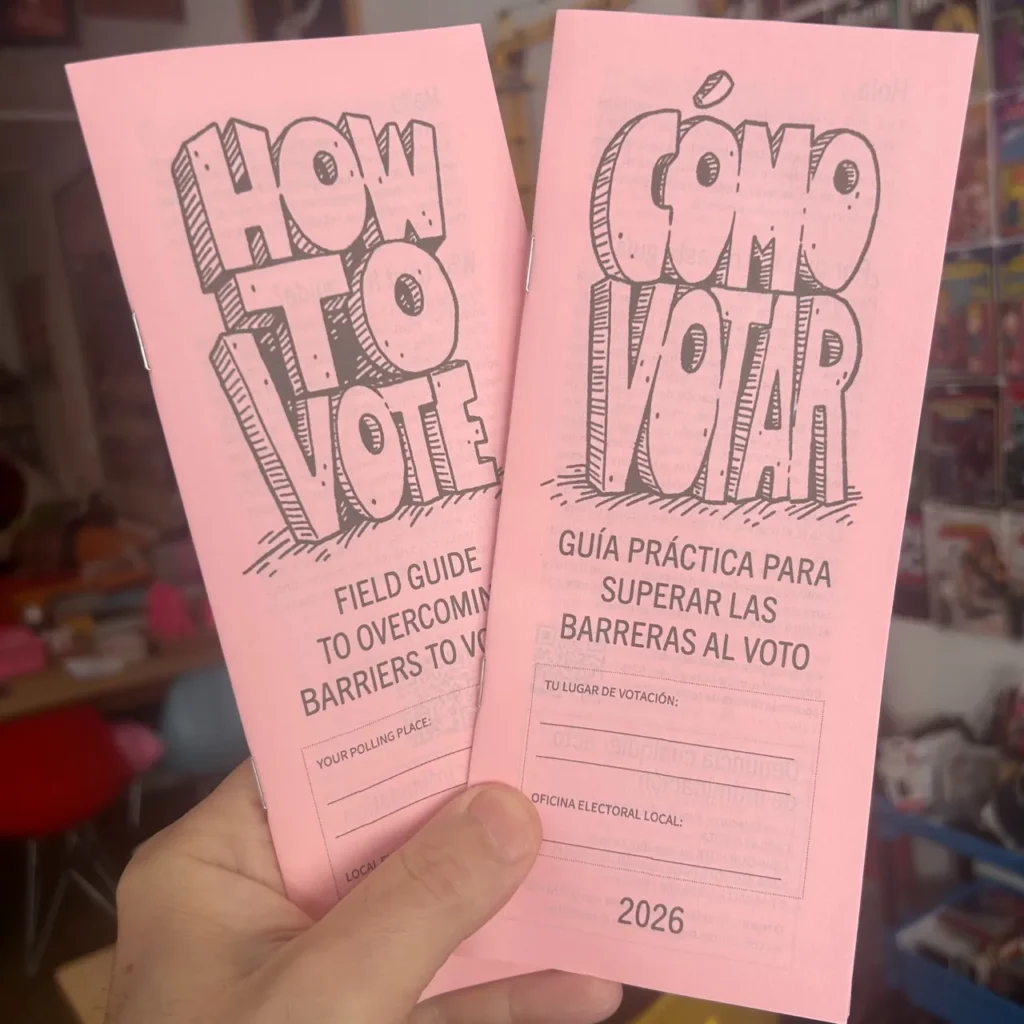
I recently got to contribute Schoolhouse Rock-inspired cover illustrations to this bilingual zine on overcoming common barriers to voting:
If you’re in the U.S. and want to help your neighbors get to the polls for midterms this November—especially folks who are worried about voter intimidation—this is a great resource. It’s in English and Spanish (reversible!) and came together thanks to a crack team of elections specialists, print nerds, translators, and copy editors. Particular thanks to Dana Chisnell, Mike Monteiro, and Jason Cosper for their efforts.
This bad boy is FREE TO PRINT AND DISTRIBUTE! It requires 7 sheets of paper, double-sided. There are crop marks to help you trim it down. A standard copy shop will be able to make it happen if you don’t have gear at home.
Don’t have the capacity/funds to print your own? There’s probably a local voting bloc or immigrant rights coalition who would love to have it. Help us get it into the hands of communities who need it most.
And, as always, you can check your voter registration at Vote.org.
Hi [the name is not important, this isn’t really about one guy],
As an artist who writes about the necessity of credit and compensation for my work, I was surprised to receive your message.
It’s impossible for me to know whether you’re writing these emails yourself, although at this point there are tells. I know I turn up in searches for “creators who talk openly online about money and the creative process,” so it’s easy enough to have ChatGPT write to me on your behalf thinking that I’d be a good get for a platform about owning your own creative output.
The fact is: I’m now getting 4-10 emails every day from people purporting to be enthusiastic about my work.
They are not, on the whole, written by people.
Mostly they want my money, often for vaguely-worded promises of exposure via fake book clubs, review-writing scams, offers to join new platforms (that’s you!), and “exciting opportunities” to exhibit at conventions that do not exist.
It leads me to mistrust every kind word that lands at my door.
I am, frankly, exhausted by it.
My understanding—from your own pitch and the web presence you’ve built for your platform—is that generative AI is essential to your ideal user base and your own process in building the platform. This flies in the face of the values that have made my career possible.
Generative AI relies on stripping labor from thousands of creators without fair compensation. It is laughable to me that you’d write to me specifically about my writing on money and expect me to be “excited” about this opportunity. You might be trying to push back on the devaluation of creative work by building something where creators do get compensated for the full process behind their output. Maybe your heart’s in the right place. But I’m not interested in aligning myself with platforms that put AI-generated work at the center of what they do.
If your primary aim is to create a future economy where creators are compensated for their labor, I’d advise you to pick a different method than the one you’re throwing your energy behind.
If you haven’t caught the news, there’s a fancy new page on the site all about Seacritters! The Hunt for the Jigamaree, my upcoming swashbuckling graphic novel with writer Kate Milford and colorists K. Czap and Natalie Riess—and just in time! This week Barnes & Noble is running a big preorder sale that includes our book! You can use the code PREORDER25 to get a hefty 25% off from now till Friday, 9/11/26. (This offer is for B&N rewards members, but it’s basically like a free frequent flier program. Should be easy to sign up for.)
If B&N doesn’t float your boat, I’m always a fan of preordering from your local indie bookstore or requesting that your library carry the book. More info about all of that here. There will be other sales and promotions for preorders between now and the book’s publication date next March, so if money is tight or you gotta skip this one, never fear.
And why does all this matter, anyway? Well, to traditional publishers, preorders are what it’s all about. They let booksellers, librarians, reviewers, and the marketing department know that people are excited for this release, which means they’ll put more energy into helping us get it into the world. It’s proof of concept.
They also impact our potential placement on bestseller lists when the book comes out. Those “instant bestsellers”? They’re actually the accumulation of every preorder received before the book’s release—not the number of books sold the week the title comes out.
All that to say: preorders do matter! A lot!
There are so many things about traditional publishing that I assume everyone already knows, and I have to keep reminding myself that I didn’t know a lot of this stuff before I started dipping my toe into non-Kickstarter-funded book-making waters. It’s opaque and nonsensical and often deserves a clarifying word or two. I’m learning as I go. Here’s to sharing more of that along the way.
Heads up for you blog-reading types: I’ll be teaming up with my friend Mike Monteiro next Friday (August 28th!) to offer an info-packed 90-minute online workshop on MAKIN’ BOOKS.
Mike and I have decades of combined experience crafting books, graphic novels, zines, and weird one-off projects from start to finish, and we want to help YOU finish making your thing! We’ll be diving into managing creative projects, tackling print design, traditional vs “self” publishing, The Dreaded Promotion Fandango, and everything else we can think of.
Subject matter is dependent on who shows up and what they’re interested in, so bring us your specific quandaries. (I also have it on good authority there will be helpful creative folk scattered throughout the audience, in case you’re hunting for a good editor, print broker, or other ally in your quest.)
How to Make Books takes place on Zoom from 10-11:30am Pacific Time on Friday, August 28th. Tickets are $55.20, but if you’re a Patron of mine you get a special 10% discount code at the end of this post. Can’t afford to attend? Drop me an email and I’ll see what we can do. I want this information to be available to folks who need it.
I’m spending a lot of time at memorials these days.
Partly it’s to do with living in a small town with a median age well above the national average. Partly it’s to do with loving people, being close to them, and wanting to stay present when they go.
I had the chance to speak about my 7th grade teacher, Peter Thielke, this past Saturday. I think more people should know about this lovely man, so I’m republishing my speech on my blog. Writing—and especially writing that expects to be read aloud—has been feeling so alive to me lately. Good thing, too: I have to write another one of these (for my dad, no pressure) in the next five weeks.
Anyway, here are some words:
Hello, everyone. My name is Lucy Bellwood. I had the great joy of being Peter’s student almost 25 years ago.
I was twelve when we met. The teachers I’d had at Oak Grove up till then had taught me many things, but a fluent understanding of mathematics was not among them. I entered 7th grade carrying a level of insecurity around the subject that often left me near tears.
Peter was into math the way other people are into sports teams. His patient encouragement, carrying over into many after-school study sessions, taught me to tolerate the discomfort of not knowing. I didn’t learn to love math that year, but I learned that it rewarded persistence; that I was capable of arriving at an answer. I know now that this is a much higher predictor of success than intelligence or expertise.
He taught me many truths, but there was one lie I carried for years after leaving his class.
We’d built our own desks that year. The classroom was littered with them—some low and curved, others precise and upright, some with drawers and some without, all in shades ranging from deep mahogany to pale birch. Each one felt like an extension of the student who’d built it. (Mine, a low walnut crescent moon, is now a desk for a twelve-year-old I love in Ojai. I’ve visited another in Flagstaff, Arizona. A third sits in a classmate’s parents’ living room on Shady Lane. They stay with us.)
I’d spent years telling people that yes indeed, my 7th grade teacher taught us to design and build our own desks. It felt like the perfect encapsulation of my time at Oak Grove.
So when I had the chance to see Peter in the months before his death, I made sure to tell him about my desk, and about the people I’d shared it with, and how grateful I was he’d given us that freedom to experiment and learn under his guidance.
He raised his eyebrows. “But that was your idea.”
I was speechless. He was insistent.
He said that yes, he’d had students build desks every year, but before our class came along they’d all been built to the same specifications. “It was you, Lucy Bellwood, who asked why you couldn’t each come up with your own designs.”
How could I have forgotten?
“I had a bit of an educator’s crisis about it,” he admitted. “I went home and wrestled with the idea for days before I said yes—and then it turned out to be so fun.”
My appreciation for his teaching deepened so much that morning, because it was clear that none of this happened by accident. Peter weighed the options, and then he made a choice. Guiding sixteen kids through their own design process was undoubtedly more work than having them build from a single plan, but it was the richer option by far.
Granted: there were limits. He said I’d wanted a four-poster frame with a canopy as part of my design, which was a firm no-go. This, too, is good teaching. Sometimes we need guardrails. But he said “yes” to us in so many other ways—when we wanted to build a ladder to the loft in our classroom or paint a mural on the wall. He gave us ownership of our quest for knowledge.
In the months since that conversation, I’ve realized how much Peter’s skill as a woodworker infused his teaching practice. Wood, like people, has its own opinions about where it wants to go. Education is often conceptualized as a top-down process—the expert imparting wisdom to the inept. Peter understood that it is far more rich and strange: the teacher reveals to the student what they are capable of. He honors their curiosities, their instincts, their passions. He collaborates. He brings out the luster of the grain.
My father died almost a year ago. His decline was long, and marked by a lack of lucidity that meant I never got to have the kinds of conversations with him that I had with Peter. Caring for my dad over the last five years of his life left me out of touch with myself, but it also brought home the truth that it is vital to spend time with the people we love while they are alive. This is true whether or not they can carry on a conversation. We must tolerate the discomfort of not knowing how long we have.
As I cycled home from my last meeting with Peter, still crying through the scent of orange blossom, I remembered more about the 12-year-old I’d been. I’d spent so much time focusing on her inexperience, her insecurity, her bad-at-math-ness, that I’d forgotten her creativity and boldness. I’d forgotten about her willingness to try.
This was the gift he gave me. Even after so many years and so many students, he saw me at a time when I was, once again, struggling to see myself. And he gave that gift the same way he always had: with ease and humor and encouragement—even in the face of his own mortality.
This is what the very best teachers do: they give us back to ourselves.
Thank you for being here to celebrate him. May we each carry on his work in our own way.
We’ve got our celebratory Seacritters-Book-1-is-Nearly-Done Community Zoom coming up tomorrow, but I also wanted to release this comic in time for the opening of its physical exhibition in Savannah, so we’re getting a double-barrel week on two very different emotional notes.
As some of you might recall from this essay, I spent the latter half of 2025 working on a comic for the Ships of the Sea Maritime Museum in Savannah, Georgia. Tania Sammons, a curator at the museum who had previously licensed my guide to sailors’ tattoos for a show, wrote to me with an irresistible pitch: four cartoonists would be hired, assigned a vessel from the museum’s extensive collection of models, then given six months to produce a short comic for publication in an anthology alongside an accompanying museum display.
How could I say no?
My original brief was to research the Anne, the ship that brought the first colonists to Georgia, but in the aftermath of my dad’s death the story took off in directions I couldn’t have foreseen.
Unexpected research moment: running into my own work at the Santa Barbara Maritime Museum while hunting for a particular model ship.
I’m tempted to write up a great big description of the whole process, because I’m out of practice releasing things and it feels as if there’s so much to explain, but I’d like to let the comic speak for itself. I’ll include my artist statement and a couple photos from the museum exhibit below, and if you happen to be in Savannah you can stop by and see it all in person starting Friday, May 1st! More details about that here.
Content Warning: this comic deals with suicide and parental mortality. Readers with trypophobia may want to skip pages 14 and 15.
Exhibit Preview
Artist Statement
I joined the crew of my first tall ship at seventeen. I know more than most the temptation to cast a vessel as the hero of the story, but it’s a lie. We name them, adorn them, and rely on them, but ultimately ships are tools enlivened by the people who use them. They encompass exploration and cultural exchange, escape and immigration, enslavement and genocide. Rather than flattening the ship into a hero, I want to examine the ship as a vessel in every sense of the word, one brimming with discoveries and losses alike.
In her essay The Carrier Bag Theory of Fiction, Ursula K. Le Guin invites us to explore the implication of the container as the oldest human invention. What would it mean to acknowledge that we have carried sustenance and stories in baskets, nets, and bottles for far longer than we have centered narratives around a Hero’s Journey built on aggression and conquest? “It’s hard,” she admits, “to tell a really gripping tale of how I wrested a wild-oat seed from its husk, and then another, and then another, and then another, and then another—” but the essay encourages us to try.
Whether framing the hull of a ship or the panels of a story, we delineate the things we love. It is an affection that cannot be rushed. I was lucky enough to learn from many model ship builders in the course of creating this piece. Their generosity, enthusiasm, and expertise helped me appreciate what’s poured into each miniature vessel, and to recall something I need to keep close in my own practice: there is value in doing things that defy efficiency. These are fields where monotony walks hand in hand with craft. Some people throw their hands up and bemoan the death of such practices in the age of AI, but I believe we’re headed toward a resurgence in valuing the things machines cannot do.
There is nothing more human than dying. Steeped in my own grief at the loss of my father, I found my way into a story that took me places I couldn’t have foreseen. Early in the research process, I read that the colonists aboard the Anne slept below decks in suspended wooden cots—their similarity to coffins a reminder of how often such voyages become a passage to the underworld. Every journey requires a type of death. We leave behind our former selves, hoping to meet some new incarnation on the farther shore, but the past always comes with us in one guise or another.
We don’t know what became of the Anne in the end; her own death, whatever that means for a vessel, went undocumented. Sometimes such losses are inevitable. But the containers we build, whether they be ships, comics, or museums, offer us a chance to see ourselves woven into the minutiae of the past. It is a form of immortality, one that relies on engagement, imagination, and tenderness, and it is always worth reaching for.
Another annual reading list I’m putting up without much commentary, but there were some bangers in 2025. “The point seems to be this,” Kate Briggs writes, “left to its own devices, the path of reading is very rarely chronologically ordered, thematically coherent, limited by language or respectful of borders. Books open out onto, they cross with and follow haphazardly on from one another. Left to its own devices, the path of reading strays all over the place.”
Turns out I’m two years behind on these so I’m getting ’em up! No commentary because I gotta run out the door to ink more pages of Seacritters, but hopefully I’ll come back to this down the line.
One week from today (Tuesday, December 16th at 6pm) I’ll be at my beloved local outdoor bookstore, Bart’s Books, for an interactive evening with fellow Ojaian and powerhouse cartoonist Shay Mirk.
We’re celebrating the publication of Making Nonfiction Comics, a comprehensive illustrated guide for everyone who’s ever wanted to tell stories about the world around us in words and pictures. (If you can’t make the event, that link takes you to bookshop.org where you can buy the book online.)
Look at this chonker!
This beast is a collaboration between Shay and fellow cartoonist Eleri Harris and it is so!! good!!! In addition to Eleri and Shay’s hard-won expertise, there are also interviews and tips from so many big names in the field. You can learn about crafting everything from on-the-ground protest reportage to deep dive historical research to authentic personal narrative. This book is going to be the gold standard for years to come.
I feel lucky to have a brief cameo talking about running a community drawing night in Portland for several years in the twenty teens. Here’s a look at that:
This baby can fit so many cartoonists in it! (2013)
If you’re in the area, do come by. I’m gonna show off some kelp farming comics, Shay’s gonna talk about making the book, it’s gonna be very fun. Ojai may be 80º during the day right now, but it gets chilly after dark, so bundle up! We’ll have zine templates for folks to fill out and fun slides to share and, knowing Shay, killer snacks.
A quick one to say I’ve been thinking a lot about the different subtitles they’ve slapped on Lewis Hyde’s The Gift through the years, mostly because it was only this year I learned that the original 1983 edition looked like this:
I LOVE IT. WHY DID THEY CHANGE IT. WHAT GIVES.
The whole thing is a far cry from 2019’s:
As well as the copy I first encountered (published in 2007), which features a third option:
Which is…fine? It’s fine.
BUT WHO BURIED THE LEDE ON THE EROTIC LIFE OF PROPERTY?!
Audre Lorde originally presented “Uses of the Erotic: The Erotic as Power” as a paper in 1978, but it wasn’t published in Sister Outsider until 1984—just one year after the first edition of The Gift came out.
(There’s a nice write-up of this design on Fonts in Use, if you’re into that sort of thing, *cough*ROBIN*cough*)
I wonder about this post-70s literary landscape, everything still reverberating with the energy of the 60s, the explosive visibility of sexuality in American youth culture, the rising tide of queer voices—but also the broader definition of eroticism.
I just re-read Katherine Angel’s Unmastered: a Book on Desire, Most Difficult to Tell, which I picked up after Tomorrow Sex Will Be Good Again. Her exploration of eroticism veers more towards the question of what to do with desire that resists being codified, named, and negotiated in explicit terms. How do we reckon with consent culture alongside the lure of the unknown? What of discovery? What of the secret third thing?
Kate Wagner coming in at the right moment here with this essay:
A situational eroticism is what is needed now, in our literalist times. […] Arousal is a matter of the self, which takes place within the body, a space no one can see into. It is often a mystery, a surprise, a discovery. It can happen at a small scale, say, the frisson of two sets of fingers in one’s hair at once. It is beautiful, unplanned and does not judge itself because it is an inert sensation, unimbued with premeditated meaning. This should liberate rather than frighten us. Maybe what it means doesn’t matter. Maybe we don’t have to justify it even to ourselves.
This draft has been languishing because I don’t have a neat bow to slap on the end of this. If there’s anything I’m thinking of, though, it’s that Hyde (or his publisher) wasn’t wrong to foreground eroticism in that first edition of the book. Eroticism is creativity, and neither are as much work as they are play.